Market PulseDelayed market data
Delayed market quotes load when the page opens.
Featured Research
Thematic Investment Intelligence

Who Wins in AI?

AI can succeed technologically while parts of the infrastructure financing boom fail to earn their cost of capital. The first winners are visible; the final payers are not.

Who Wins in AI? Semiconductor infrastructure, data centers, capital contracts and monetization across the AI value chain

Strong cloud operating profits and contracted backlog support current demand. They do not prove that every capital cohort will earn its required return, especially when model-lab financing and supplier commitments interconnect.

The report compares both spending-period diagnostics, examines the laboratory and supplier exposures, and establishes measurable 2027–2028 reassessment gates without presenting unsupported scenario probabilities.

Capital-recovery diagnostics

Cross-period comparisons and commitments; not realized returns on invested capital

Research cutoff: October 31, 2026
2025 cash-capex basis
51.9%
Cloud-revenue growth / cash capex · diagnostic
2026 planned-capex basis
26.4%
Cloud-revenue growth / planned capex · diagnostic
NVIDIA supply commitments
$279B
July 2026 filing · includes memory and manufacturing

Recent Research

Previously featured and current research

View all research →
Research Article

Who Gets Paid for the AI Buildout?

NVIDIA, CoreWeave and Applied Digital before TSMC. More capacity and stronger demand do not guarantee more value for common shareholders.

AI Infrastructure · NVDA · CRWV · APLD · Oct 14, 2026Read report →
Editorial Perspective

What If AI Is Changing Its Own Economic Clock?

Could AI's accelerating economics change the timetable for an infrastructure correction? An editorial hypothesis, with independent MAi research still pending.

AI Economics · Economic Cycles · Oct 9, 2026Read report →
Deep Meta-Analysis

Built for Complexity, Not Just Capacity

Micron's results strengthen the case that Lam Research is riding a longer equipment-intensity cycle, but the capital is building cleanrooms before it becomes tools.

Semiconductor Equipment · LRCX · Sep 30, 2026Read report →
Deep Meta-Analysis

When Time-to-Power Meets the AI Capital Stack

Project Jupiter is not evidence that AI demand is collapsing. It is evidence of what happens when infrastructure commitments move faster than power—and the cost of delay reaches a balance sheet with less room to absorb it.

AI Infrastructure · ORCL · Sep 29, 2026Read report →
Earnings Preview

Micron: The Print Is Likely Strong. The Margin Guide Decides the Stock

Micron is likely to deliver another powerful quarter. The next gross-margin guide and fiscal 2027 capacity plan may matter more to the stock than the headline beat.

Semiconductors · MU · Sep 28, 2026Read report →
Power & Energy

How Much Power Will Be Enough?

A regional shortage is forming in the U.S. grid. The equipment makers helped reveal it — but the stronger near-term financial opportunity may be in the companies already monetizing scarce, dispatchable generation.

Power & Energy · Sep 27, 2026Read report →
Winter Outlook

The Long End Joined the Selloff

A six-month current-state baseline across Treasury stress, inflation, labor, housing, household buffers, energy pressure, AI capex and the shock channels that could turn resilience into broader deterioration.

Macroeconomics & Markets · Sep 24, 2026Read report →
Deep Dive

The Networking War Beneath AI: Where NVIDIA Actually Stands

Follow the competitive architecture beneath AI infrastructure — switches, interconnect, open standards, endpoint control and the economics that sit around the accelerator.

AI Infrastructure · ArchiveRead report →
Meta Analysis

The AI Money Loop

Tracing how capital, capacity, compute demand and infrastructure spending reinforce — or constrain — one another.

Capital Flows · ArchiveRead report →
Thesis Follow-Up

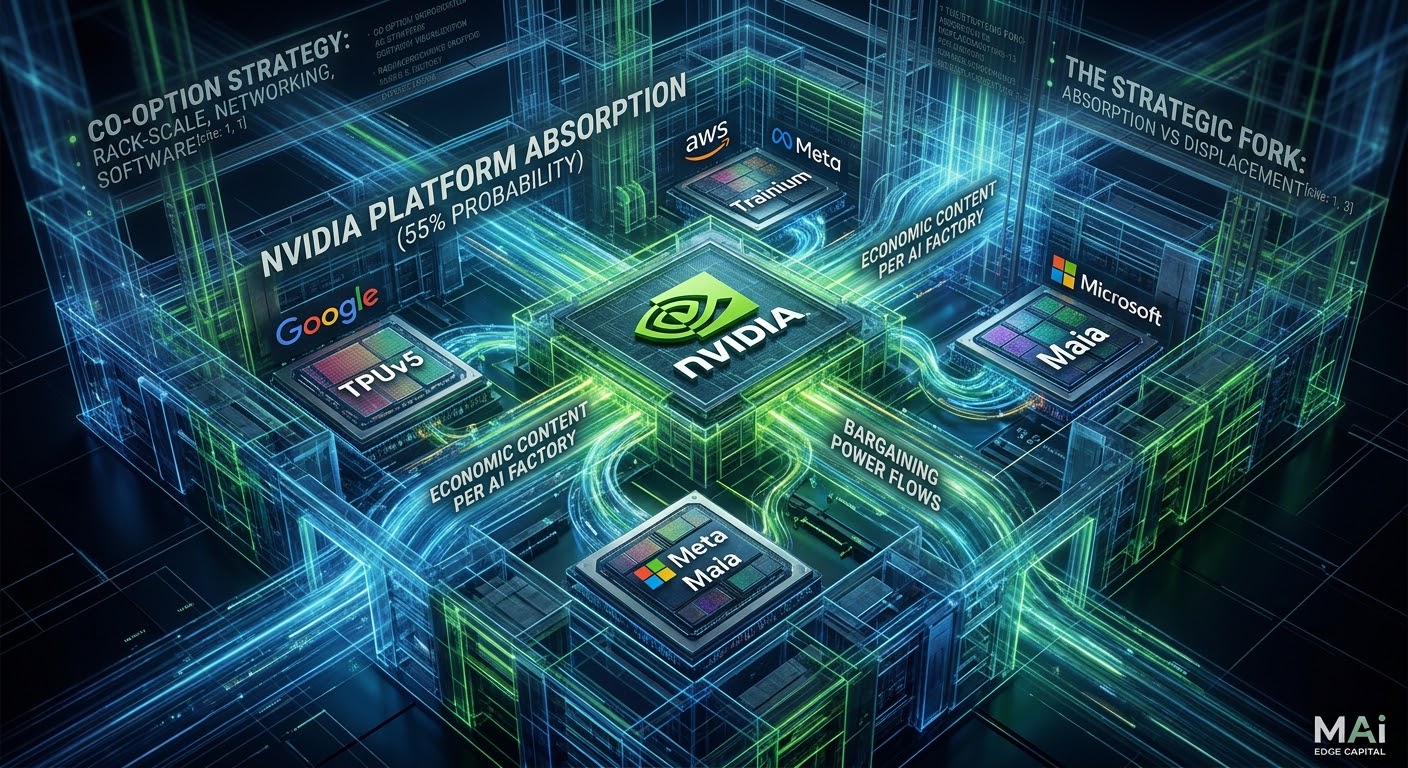
NVIDIA and the Custom-Silicon Threat

Re-underwriting an earlier thesis as hyperscaler custom silicon scales and NVIDIA shifts the strategic battleground.

NVIDIA · Aug 22, 2026Read report →
AI Infrastructure Outlook

AI Has Crossed the Chasm. The Infrastructure Buildout Is Just Beginning.

A long-horizon investigation of AI adoption, accelerated compute, memory, networking, power, cooling and the infrastructure derivatives of a broader adoption curve.

Adoption & Infrastructure · ArchiveRead report →
Notifications

Know when something new is published.

We publish selectively. Deep investigation and MAi Researcher deliberation set the pace of our research reports. Choose what you follow and how you’re notified; change your preferences anytime.

Why MAi Edge Capital exists

Investors do not suffer from a shortage of information. The problem is that the information is fragmented, the analysis is often incomplete, uncertainty is frequently blurred into opinion, and conclusions can become stale long before the article that produced them does.

A financial story can be factually correct and still leave out the evidence that changes the outcome.
MAi Researchers investigate what sits around the immediate story: suppliers, customers, contracts, manufacturing capacity, infrastructure constraints, capital expenditure, competitors, macroeconomics, geopolitics and the second- and third-order relationships that conventional article-level analysis can leave disconnected.
Fragmented evidence

Important facts can live across different companies, industries, filings, markets and data sources without ever being assembled into the same thesis.

Uncalibrated judgment

Fact, interpretation and prediction are often presented together. We separate them and make uncertainty visible rather than hiding it inside confident prose.

Point-in-time thinking

An investment thesis should not freeze on publication day. New evidence should strengthen it, weaken it or force it to be rebuilt.

How the edge is created

MAi Edge Capital uses a governed multi-AI research process designed to reduce the weaknesses of single-source and single-model analysis. The work is investigative first, adversarial second, and synthetic only after the evidence has been challenged.

No intelligence — human or artificial — should be self-validating.

The MAi Research Team expands the investigation beyond the obvious evidence, uses independent model perspectives, searches for contradictions and falsifiers, preserves meaningful dissent, and reconstructs the evidence into the most defensible current read. When direct evidence is incomplete, the system can continue through meta-inference rather than pretending the unknown does not matter.

01

Expand the investigation

Start with the company or thesis, then move outward into suppliers, customers, capacity, contracts, infrastructure, policy, macro and second-order effects.

02

Investigate independently

Multiple AI models and specialist research roles examine the evidence without beginning from a shared conclusion.

03

Challenge the thesis

Contradictions, falsifiers, weak sources, alternative explanations and meaningful dissent are surfaced instead of averaged away.

04

Cross-correlate

Evidence that appears unrelated is connected across companies, markets and time so the larger causal structure becomes visible.

05

Update continuously

The thesis remains a living research state. Probabilities, branch conditions and conclusions change when the evidence changes.

The Capital edge
The edge is not knowing the future. It is knowing more of what could determine it — and continuously updating the probability as the evidence changes.

What the research gives you

The objective is not more financial content. It is a different class of investment intelligence: connected, explicit about uncertainty, traceable to evidence, and designed to help investors make their own decisions from a more complete picture.

Connected thesis

See the system around the company

Research links the company to the external forces that can materially alter its economics, competitive position and market expectations.

Probability

See uncertainty instead of hiding it

Where the evidence supports more than one path, the research presents branch probabilities, conditions and what would change the current read.

Evidence

Follow the reasoning back to source

Conclusions are connected to an evidence chain so readers can inspect what is known, what is inferred, what conflicts and what remains unresolved.

Continuity

Return to a thesis that evolves

Follow-up research does not start over. New evidence is connected to prior conclusions and the earlier call can be scored against what actually happened.

The immediate story is only the center node.

A serious investment thesis can depend on evidence far outside the company itself. MAi Researchers deliberately expand the search perimeter until the relevant evidence network has been investigated, challenged and reconstructed.

CompanyCustomersSuppliersCapacityEquipment ordersContractsCompetitorsTechnology shiftsHyperscaler CapExPower & coolingMemoryNetworkingMacroeconomicsRates & liquidityGeopoliticsRegulationSecond-order effects

Research across the forces that move capital

MAi Edge Capital is not organized around a single ticker or a single asset narrative. Research follows the dependencies that can change an investment outcome.

01

Companies & theses

Current thesis, evidence history, valuation questions, catalysts, risks and thesis changes over time.

02

AI infrastructure

Compute, networking, memory, power, cooling, data centers, supply chains and the capital required to scale them.

03

Macro & capital flows

Rates, liquidity, inflation, credit, fiscal conditions, investment cycles and the transmission of capital through markets.

04

Geopolitics & policy

Trade, regulation, industrial policy, export controls, sovereign risk and geopolitical conditions that can reshape company economics.

Trust the research by inspecting the machinery

You should not have to understand the full MAi architecture to read an investment article. But if you want to understand how the research is produced, governed and validated, the path should be available.

Progressive trust

Start with the conclusion. Go as deep as you want.

At the publication layer, readers see the research, the sources, the thesis history and the current conclusion. The deeper methodology and architecture remain discoverable for readers who want to evaluate the research system itself.

The long-term product

From reading our Research Team to putting one to work.

Free research demonstrates the capability. The future premium service extends that capability directly to the investor through governed access to the MAi Research Team.

Read what MAi Researchers discovered for free.
Pay to have MAi Researchers investigate what matters to you.
Research Team access · coming later
Selected advertising and affiliate relationships may appear on MAi Edge Capital · editorial conclusions remain separate
MAi Edge Capital is published by MAiFrameworks LLC, a Georgia limited liability company. Founder & Executive Publisher: Dennis Schirmer