Research: MAi Edge Capital Research · Executive Publisher: Dennis SchirmerPublished by MAiFrameworks LLC, a Georgia limited liability company.
Market Pulse
Oracle is the primary credit transmission channel
Publication metadata: ORCL is the primary security. OWL and BE are included because the article substantively analyzes Blue Owl's capital exposure and Bloom Energy's project-timing exposure.
ORCL · Oracle
Oracle Corporation
Live at publication
MAi Edge Capital Market Pulse · single-source market feed · 15-min delayed when available
30-session chart will hydrate from the production market-data layer. No stale fallback price is rendered.
OWL · Blue Owl
Blue Owl Capital
Live at publication
MAi Edge Capital Market Pulse · same source and as-of convention as ORCL
30-session chart pending production market-data hydration.
BE · Bloom Energy
Bloom Energy
Live at publication
MAi Edge Capital Market Pulse · same source and as-of convention as ORCL
30-session chart pending production market-data hydration.
Static quote values were removed from this draft because the prior cards mixed aggregators and did not meet the publication market-data standard. Production must hydrate all three securities from one source and label source, as-of time, delay status and chart window before release.
The question that triggered the investigation
“What do you think of the Oracle fiasco?”
The short answer: real problem, wrong label. Project Jupiter has a genuine permitting and time-to-power problem. But the evidence does not currently support the more sensational versions of the story: a Blue Owl retail-private-credit blowup, a sudden 21,000-person Oracle layoff, or proof that AI infrastructure demand is collapsing.
The stronger finding is that a recurring time-to-power bottleneck is colliding with an unusually stretched Oracle capital structure.
What the headlines say · what the evidence shows
Confirmed problem
“Oracle fiasco”
Jupiter's power path is genuinely constrained. The project still needs the microgrid air-permit process resolved, while the gas lateral lost its original fast-track and the pipeline's in-service date is reported to have moved to February 2027. Oracle nevertheless says the project remains on its planned schedule.
Directionally right
“Bond yields and CDS are surging”
Oracle credit has deteriorated materially. That is the channel worth watching. But part of long-bond weakness reflects rates and duration, and Jupiter is one input into Oracle's credit story—not proof that Jupiter alone caused the repricing.
Corrected
“They just laid off 21,000”
Oracle's 10-K shows headcount falling from roughly 162,000 to 141,000 over the full fiscal year. Cost reduction and restructuring are real and continuing; there was no single 21,000-person Jupiter-related layoff.
Two issues, wrongly connected
“Blue Owl retail private credit is the alarm bell”
Blue Owl's non-traded credit vehicles have faced elevated redemption requests. Jupiter, however, appears to sit in institutional real-assets / digital-infrastructure structures. The connection is valuation, fundraising and reputation—not evidence that Jupiter losses sit inside the retail credit products.
Partly unverified
“$18B debt is under pressure”
A reported ~$18 billion project financing is described in multiple press accounts, but the underlying loan documents, exact terms and dealer marks have not been obtained. Reported pricing is consistent with Jupiter financing transmitting Oracle credit risk rather than behaving like a stand-alone project-default event.
Principal unresolved fact
“Three-year rent holiday”
The private Project Site Lease governing Oracle's economics with the developer has not been obtained. Public IRB lease language does not settle the commercial carry obligation. The three-year deferral/carry mechanics therefore remain disclosed but excluded from decision weight.
The mechanism
Time-to-power is the bottleneck. Oracle is where the financing strain can surface.
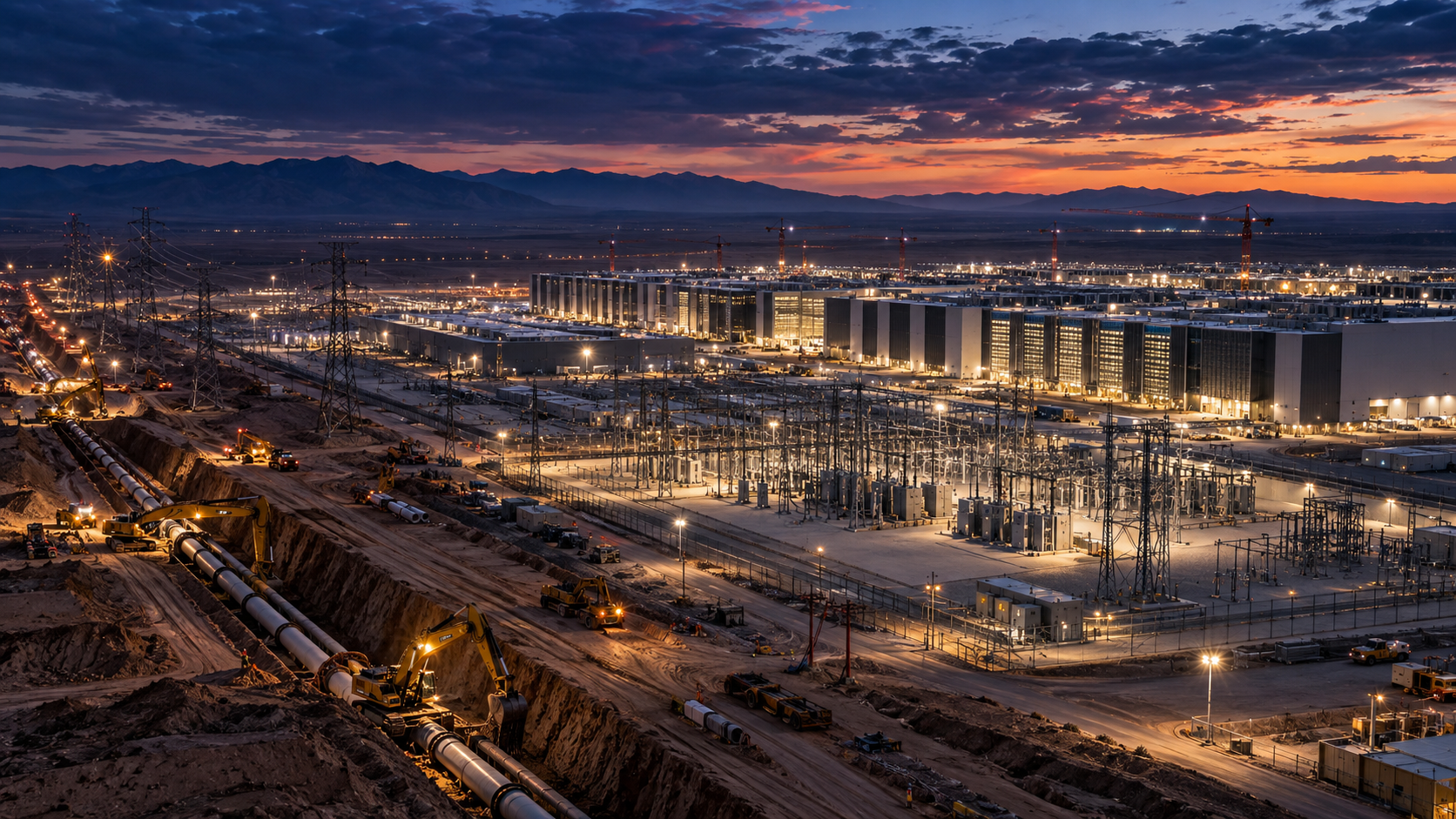
Jupiter was designed around behind-the-meter power. Oracle and its partners shifted the plan to as much as 2.45 GW of Bloom Energy fuel cells, and Oracle publicly stated that it would bear all energy costs. The project therefore depends on both a fuel-cell microgrid permit and a dedicated gas lateral.
The physical constraint is not unique to Oracle. The recurrence is visible in named projects: Wisconsin regulators reportedly ordered American Transmission Company to restart the Port Washington grid-connection application in August 2026; Michigan's Attorney General is appealing the MPSC approvals supporting the Saline Township Oracle/OpenAI campus; a planned Abilene expansion was reported dropped with roughly a year of power unavailability among the cited reasons; and Entergy Louisiana filed for seven additional gas plants totaling 5,278 MW to support Meta's Hyperion expansion. The Wisconsin action and Abilene rationale remain reported items rather than retrieved regulator/order text; the Michigan appeal and Entergy filing are primary-sourced.
Project Jupiter's own public schedule also shows the tension. Doña Ana County still lists initial operations as anticipated in Q4 2026, while Oracle's Q4 FY26 earnings-call summary says customer delivery begins in the first half of calendar 2027. Those labels are not necessarily identical milestones, but they are different calendar targets. At the September 29 freeze, the microgrid's air-permit process remained unresolved and the gas lateral's in-service date was still reported, not primary-sourced, for February 2027.
That changes the interpretation: the important question is not whether Oracle's sites are uniquely delayed, but which balance sheets can absorb delay without changing financing economics.
Oracle enters that test with negative free cash flow, very large capital expenditure, substantial debt and $288 billion of additional data-center lease commitments that had not yet commenced as of its August 2026 quarter. That makes a common infrastructure problem more financially consequential for Oracle than for hyperscaler peers with stronger internal cash generation.
Capital stack
The $125B IRB number is not $125B of new Oracle debt
Doña Ana County's Series 2025C documents identify Oracle America as purchaser of approximately $125 billion of industrial revenue bonds. That number must be interpreted carefully. New Mexico IRBs are commonly self-purchased structures used to place project property under nominal public ownership for tax-abatement purposes; the authorized principal is not equivalent to third-party cash debt.
The publishable conclusion is narrower: the word “tenant” understates Oracle's economic role. Oracle appears to finance substantial equipment and power layers itself. That is why a power delay can transmit directly into Oracle's own cash requirements even if the developer and bank financing remain structurally intact.
Blue Owl
Real exposure, different mechanism
The original concern about Blue Owl was worth investigating, but the research separates two businesses that headline coverage tends to collapse together. Blue Owl's retail-oriented credit vehicles have experienced redemption pressure. Project Jupiter, by contrast, is tied to the firm's institutional digital-infrastructure / real-assets strategy.
That does not make Blue Owl immune. A prolonged Jupiter delay could affect asset marks, performance economics, fundraising and the credibility of the broader digital-infrastructure franchise. What the evidence does not currently show is Jupiter losses flowing directly through Blue Owl's retail private-credit funds.
The strongest contradiction
Demand is still there
The strongest evidence against a broader AI-capital-stack break is upstream demand. GE Vernova has reported rising gas-equipment backlog and slot reservations. Bloom raised 2026 guidance. OpenAI continues to report rapid revenue growth and enormous compute requirements. Oracle itself says the New Mexico site remains on track.
That matters because it keeps the failure mode specific: this is not yet a demand collapse. It is a conversion problem—turning contracted compute demand into energized, permitted, revenue-producing capacity fast enough to justify the financing committed around it.
Probability-weighted interpretation
The reconciled MAi posterior
H1 · Contained project event20–30%Permits clear; the structure absorbs a schedule slip; limited read-through.
H2 · Time-to-power + Oracle concentration50–60%Broad physical bottleneck, but delay cost concentrates on Oracle's stretched financing profile.
H3 · Architecture-wide repricing15–25%Financing costs reset broadly across AI data-center SPVs and new builds slow materially.
Freeze: September 29, 2026. Ranges are research posteriors, not trading instructions.
Event Gate
What changes the read next
Sep 30 / early Oct
OCIC Q3 tender closes September 30; results and any proration disclosure become the earliest read on retail-credit redemption pressure inside the window.
Oct 5, 2026
FERC environmental-assessment comment close for the Green Chile lateral.
Oct 19, 2026
NMED public hearing on the YGI microgrid air permit.
Late Oct
Blue Owl Q3 results: any Jupiter mark, fundraising change or digital-infrastructure commentary.
Nov 23, 2026
NMED statutory decision deadline. Clean issuance moves probability toward H1. Denial, redesign or a new stay moves weight toward S3 and deepens H2; it moves H3 materially only if contagion appears in comparable project paper.
~Dec 10
Oracle Q2 FY27: New Mexico delivery timing, capex, free cash flow, leverage and financing commentary.
MAi Conclusion
Adam flagged the right situation and the wrong mechanism.
The evidence does not currently point to a Blue Owl retail-credit blowup, a sudden 21,000-person layoff, or collapsing AI demand. It points to a broader time-to-power bottleneck landing on one of the most financially stretched balance sheets in the AI infrastructure buildout.
That is why the highest-probability branch is not “Jupiter fails” and not “AI infrastructure finance breaks.” It is that permitting and power delays become recurring costs that Oracle has less room to absorb than its better-capitalized peers. The private Project Site Lease remains the principal unresolved fact because it determines precisely how much of that delay cost Oracle must carry during force majeure.
Posterior: H1 20–30% · H2 50–60% · H3 15–25%.
Open the full MAi Research Report
Primary evidence
Sources carrying decision weight
Oracle Q1 FY27 10-Q$288B additional lease commitments, debt, cash and restructuring disclosures.
Secondary reporting was used for lead discovery, narrative and unverified market pricing only. Exact private lease economics, reported project-loan trading levels and the reported February 2027 pipeline in-service date remain outside decision weight unless independently confirmed from primary evidence.
Disclosure
Research and information only. MAi Edge Capital does not provide individualized investment, legal, tax or financial advice. Forecasts, scenarios and probabilities are uncertain and may be wrong. Market data may be delayed or unavailable. Readers remain responsible for their own investment decisions and risk of loss.
Legal & risk disclosures →